
It was a double feature made in that most haphazard of situations: a long-haul flight, with a movie selection featuring a surprising number of Academy Award nominees. As I scanned the offerings on the small screen, I picked out two films that loomed urgently on my unwatched list: the latest Pixar offering, and the reigning Best Picture winner. And they turned out to have an unexpected level of thematic similarity, both wrestling with the question of what gives a life meaning and coming to strikingly similar conclusions.
We’ve all seen this theme explored before. In the case of Soul, the premise itself – a second shot at life – is not particularly uncommon. The set-up reminded me both of the recent movie Palm Springs, where the two main characters cycle through various theories on how to earn their way out of their strange purgatory. Being a good person? Falling in love? (Palm Springs answered this question with a clear-eyed pragmatism: it’s teaching yourself theoretical physics and building your own path out.) Soul’s most obvious parallel is the beloved NBC favorite The Good Place, where characters wrestle with self-improvement in the afterlife. The Good Place covered wide ground in its 4 seasons, as summed up in this memorable tweet:
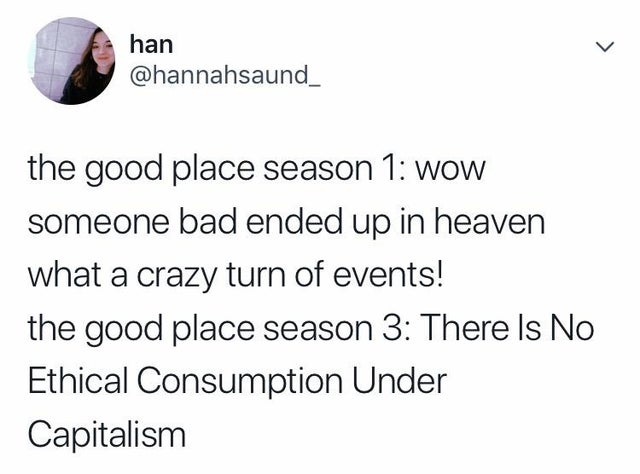
But both before and after the whole deconstructing-capitalism phase, The Good Place settled into a comfortable ethic, one that countless tales have preached before it: the thing that gives our lives meaning, that allows us to improve as people, and that fulfills our deepest desires for happiness is our relationships with other people. Like the poems and pop songs say – it’s love! Romantic love, friend love, pick your poison, but that is what’s getting us through this weird old life (and what comes after, too). When the show’s characters finally make it to heaven – the final, longed-for happy ending – it is defined mainly as time. Specifically, time with the people they love – as much of it as they want until they are completely satisfied, and ready to pass along to eternal, irrevocable rest.
So I was expecting something similar from Soul, which features a struggling musician voiced by Jamie Foxx as its protagonist, and provides a plot that first seems to track onto a common Hollywood narrative of scolding its characters for following their dreams and passions to chase success. (I always found this so rich coming from the film industry, a place where every individual listed in the credits has had to engage in a ridiculous level of career-focused tunnel vision in order to succeed enough to be working on an actual big budget movie. But I digress!)
As the plot unfolded, I settled in and waited for Soul to reveal a love interest its protagonist had neglected, A Christmas Carol style; or maybe it would be a friendship or family relationship that appeared to tug his heartstrings; or maybe even the deep bond he forged with his fellow-traveller, the soul without a body that Foxx’s character was meant to be training. But Soul opted for something different. Yes, it did spend a lot of time looking at how its protagonist had neglected certain relationships – with his mother, his barber, his students – and how these might lead to more fulfillment in his life. But the big huge secret that unlocks the joy that makes life worth it? That is discovered in a moment of quiet reflection as a leaf falls through the sky, from a tree into someone’s hand. The moments that win over a stubborn unborn soul to a human life include the simple experiences that happen to us humans, as individual bodies, not necessarily in communion with other people. The taste of a pizza; the feel of air rushing out from a subway grate; the way light filters through leaves. There is a communion there, but it is with our own sensations, our place in a human body and as an observer of natural phenomena.
Nomadland explores this isolated communion as well, but relies on striking cinematography and an intense performance from Frances McDormand to bear its message. The film presents us with a dialogue-thin, only semi-scripted world which features a cast of mostly real-life people playing versions of themselves. McDormand’s protagonist has walked away from life’s conventional structures after the death of her husband and the collapse of the factory town where they lived. She follows seasonal jobs at Amazon warehouses and national parks, living in her van, embracing a life of meditative solitude. There are two main pulls on her to reconsider this lifestyle: one comes from a potential romantic partner, and the other from a family member. But both connections fail to tether her, in the end. She chooses to wander.
The film deals closely with grief. The protagonist is mourning her husband and their entire shared life. As she explains in one scene, she feels that if she moves on then it will be like he never existed. Meanwhile, one of her closest friends from her nomad lifestyle is facing death from cancer, and passes before the end of the film. A leader of a campsite shares the story of his son’s suicide and how it has impacted him. The wanderers of Nomadland are facing the reality of mortality, and they are considering their priorities carefully.
Watching the film, I was struck by which parts of her life felt similar or dissimilar to mine. I’d seen Nomadland discussed as the ‘Amazon movie’ and was prepared for a brutal exhibit of inhumane working conditions. But the movie does not linger on its time at Amazon, and it doesn’t present anything particularly shocking. (It was moments from her other jobs – namely, scenes spent scrubbing down public bathrooms – that reminded me of my own sheltered existence.) But the balance between mind-numbing, repetitive, empty work under bright fluorescent lights, and finding beautiful things to do (either alone or with people you care about) during your time off? That struck me as similar to the deal that so many of us white-collar workers strike to make it through our office-dominated lives.
McDormand’s character may have found a more comfortable option by joining the domestic households on offer from either her sister or her friend, and accepting the norms of a more financially and socially stable life. But she is unwilling to do this, for reasons not always explained through words. It is clear that her close experiences with death are staying with her, and that she craves solitude, independence, and control. Her life is not easy as a nomad, but it contains incredible beauty.
The way that natural beauty is shot in Nomadland is breathtaking, and without words, it suggests a number of the feelings and thoughts that might be filling up the characters onscreen. There is comfort in the smallness of your own experience, and your own grief, when faced with something so massive and so lasting. There is the delight of being among that kind of beauty, witnessing it, touching it, feeling it in the smells and the air around your skin, or the water around you as you swim. It is the same sensation that my friends and I are chasing when we book holidays off of work to hike along seaside cliffs or explore forests, or crawl through foreign cities or stargaze under huge skies. She and her friends are doing the same thing, and finding it just like any of us can. They’re doing what being alive is for: experiencing wonder.
Earlier today I listened to one of my favorite podcasts, The Real Question, hosted by Vanessa Zoltan and Casper ter Kuile. Along with a guest, author John Green, they spent the episode considering the addictive power of the internet and social media, and how it can both enable and frustrate our attempts to spend time on things that matter. They conclude by quoting the poet Mary Oliver.
Instructions for living a life:
Pay attention.
Be astonished.
Tell about it.
Soul and Nomadland both struck me as stories about paying attention and being astonished. Both explored how acts of intentionally experiencing wonder can give meaning to a life that may otherwise appear lacking. And both focused on how these happen on an individual, solitary level, turning away from both financial/professional drivers and relationships to instead consider the agency that we all have to determine how we spend our lives. We don’t need anything other than our own body, our own mind, and our own attention, they suggest. When you feel completely alone in the world, that is when you begin.
Written 6 August 2021
 Baseless Fabric
Leave a comment