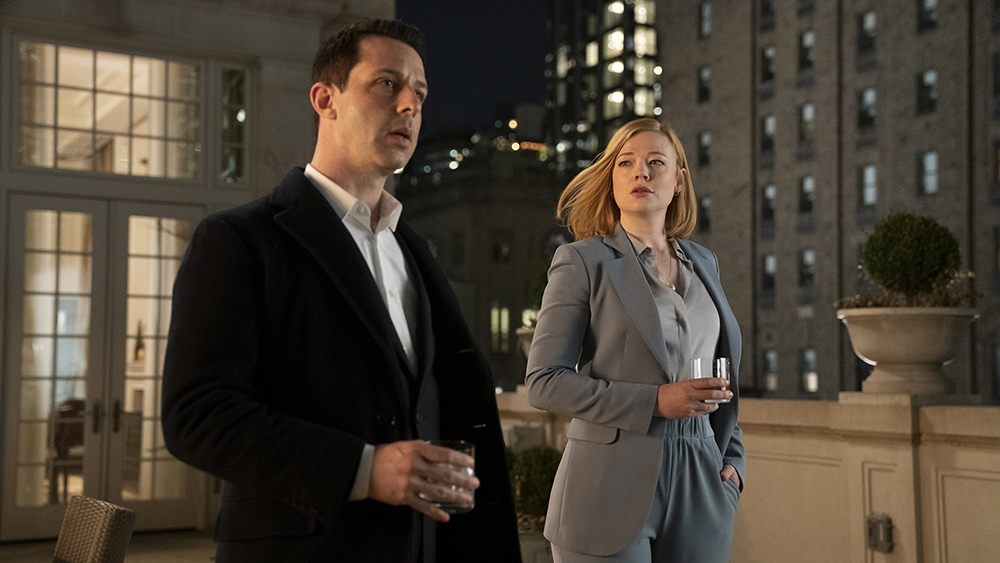
I’ve been re-watching the second season of Succession this week, partially as an impromptu celebration of the dropping of the trailer for season 3, and partially because I realized that my best friend, who is visiting from America, has never watched the show at all. (The friend in question is currently quarantined with an asymptomatic case of Covid which has trapped us inside our flat for the past week, so streaming an entire show is not only plausible but very much called for.)
Succession was a slow burn for me. I’d heard great things about it for a while before I caught up with season 1 in 2019, but I found myself dozing off when I’d stream episodes on my laptop after long days in my corporate office, exhausted and longing for entertainment that offered, if not pure escapism, at least the sort of escapism from dry business that allowed for a full focus on human drama, relationships, feelings, all the gross messy stuff of fiction that appears less sentimental when paired with dense plot.
In truth, I’d gone full sentimental since starting my job and, for the first time in years, began picking up books to read for pleasure in my moments of downtime. It was only the novels that cut through to me – no historical or political nonfiction, no business or self-improvement manuals. My minutes were precious then, and I was starving for content that drew me back into my own body again, my own mind, as a human facing human concerns.
So the second season of Succession hit like a delayed high you’d feared would be a dud. It was ecstatic and electric to see a work of fiction operate at such a high level, with every episode delivering on moments both hilarious and heavy, contemplative and zipping with dialogue. The performances are astounding, the line deliveries works of genius. We should build statues of Matthew Macfayden and Nicholas Braun. Here are my five favorite lines from the episodes that we have watched so far this week (Seasons 2, 1-7).
- But they are not, in fact, receipts!
- [Immediately afterwards] (Gasp) Greg.
- O king of edible leaves, his majesty the spinach!
- Are you asking if you can blackmail me?
- We here…for you.
Matthew Macfayden says every one of these lines.
The other great joy of Succession, of course, is watching a group of disgustingly privileged and broken people move through the world in increasingly horrible fashion, hurting themselves and others in ways both calculated and accidental, taking the forms of tragedies both commonplace and nightmarish. It’s the cousin of the kind of joy that you get watching the fall of a corrupt leader in a Shakespeare tragedy. It’s grand and grimy, meticulously crafted, a thrill to watch and fascinating to unpick.
We’ll often end an episode and sit in shock as we process what new psychological torture Logan Roy has unleashed on his children. “It’s all just about his own self-interest!” I declare, thrilled with the opportunity to unpack him like a puzzle, as we all join in the game. “It doesn’t matter that he’s old, that he’s going to die one day, and in theory something will need to happen to his company afterwards. He doesn’t care!” “He’s fundamentally uninterested in a world without him.” “So what if he ruins the company by ruining his own children? They are pawns to him, and he’ll do whatever it takes to strengthen his own position, for as long as he’s alive. His own power is all that matters. Not his legacy, and not his family.” I shook my head when he railed at Shiv that family is the only thing that matters! “His definition of ‘family’ is just obedience to him,” we vented. “Family means that he can screw them over as much as he wants, and they aren’t allowed to move an inch out of line.”
Sharing these moments (as well as the one-liners) with a friend watching for the first time is very fun. I made a family tree for her to reference when we first started, and she quickly created nicknames for many of the central characters: President Bread Goo. Depressed Don Junior. Sex Golbin. The Only Girl.
She looked at me and half-laughed, half-sighed during the recent plot line where Shiv was called forward to deal with a family scandal centered on this mistreatment of women. “See? The Only Girl.” The women are thin on the ground in the tight family world of Succession, and the show knows it. The female characters know it. It’s an interesting dynamic for a prestige show rolling into the 2020s. And by interesting, I mean: not one I’d usually put up with. But Succession is rooted in and fascinated by maleness, and the portrait on display is ruthlessly damning. Not that the evil coursing through the show stems from maleness – no, the female characters provide their equal share of self-interested moral failure – instead it seems to stem from human nature itself. But it finds its apotheosis in the patriarch.
It is not surprising that the second season found room for another strong female character to add to its ranks – a powerful, jostling executive played by Holly Hunter, who seems able to hold her own as rival and peer to Logan. Her character of Rhea Jarrell poses a revitalizing possibility for the show, much as the potential deal with her company provides one to the family. She assures the audience that we are in a world where older, experienced women wield vast corporate power as well.
And then, inevitably, she lands on a crash course with Shiv. Inevitably, the spectre is raised of her scheming taking on a sexual air. And yet her characterization is never cheap. I only realized that we were passing by these stereotypical milestones on an intellectual level – I never felt betrayed, on a gender level, by what was happening with Rhea. (It’s more than I can say for plenty of other prestige shows, on HBO or otherwise.) Perhaps it’s because the possibilities of her character are handled with delicate vagueness by the script, which avoids her sex life to instead zero in on conversations where she harnesses strategic wisdom and weaponizes her chirpy, effortless manipulations. Hunter’s handling with this dialogue is deft, and she’s having just as much fun as the established regular members of the cast.
When another character accuses her of untrustworthiness, Rhea responds:
RHEA: We’re on the same side.
NAN: No, you are on Rhea Jarrell’s side.
In a show where everyone is so transparently on their own sides, this hardly lands as a condemnation – and indeed, Nan does not mean it as one. Rhea is not morally worse than the Roys around her, and having her own agenda does not mark her out as particularly terrible in a show where even family members are not able to trust one another unless their interests align.
Perhaps this is the fundamental failure of the Roy children: they keep hoping that their father has some sort of fellow-feeling with them that might be influencing his decisions beyond a pure self-interest. But of course he’s going to keep messing Shiv around for as long as possible to put himself in a better position. He feels that he owes her nothing, and she means nothing to him beyond her usefulness. None of them do. His iconic embrace of Kendall at the close of Season 1 has nothing to do with unconditional love, and everything to do with the recruitment of a loyal soldier. As the keeper of Kendall’s unspeakable secret, Logan has ensured that their interests are now permanently aligned. He understands that this is the true currency underlying all human relationships and behavior: to know people’s self-interest is the key to power, and to control people’s self-interest is power itself.
Until Kendall breaks. It’s always my favorite part of Succession – the moments where Logan Roy miscalculates, and when that human sentiment rears its foolish head to ruin his plans and his power. Because people don’t always act in their self-interest. Sometimes something else takes over, and they become willing to make a sacrifice.
No matter how much power Logan thinks he has, even he is not immune. If you mistreat people for too long, eventually they’ll dedicate themselves to taking you down, even if this takes them down with you. Kendall is the first Roy child to untangle himself from the knot of self-interest. In its place, he chooses revenge.
It feels true, doesn’t it? It feels human and powerful, this constructed moment between made-up people. I’m in awe of this series, and I’m looking forward to getting to the end again. I hope I haven’t remembered it all wrong.
It’s maybe the defining image of Succession season 2: Jeremy Strong’s hollowed-out face, dominated by the circles under his eyes, a sunken expression on a man sinking into himself. He moves through the world as a zombie, a symbol of regret and suffering, guilt-ridden and haunted and immobilized. But at his core he’s the same as the marauding douchebag of season 1, the would-be king looking to claim his father’s kingdom. He’s still following his self-interest. The situation merely changed. He saw his dad’s plan, and his dad’s plan was better.
I can’t wait to meet the Kendall of season 3, finally free to redistribute all the pain he has swallowed. Maybe the change will take, this time. Or maybe we’ll watch Logan win once again.
Written 14 July 2021
 Baseless Fabric